
After a bit of a reading slump, I was excited this week to receive not one but five preorders in the post. But then came the tough question—which do I read first?
I have to admit, I’m very much a ‘judge a book by its cover’ kind of gal, so I’d be lying if I said that didn’t influence my decision. But I’ve fallen into the trap before—buying a book because the cover is stunning (bonus points for sprayed edges), only to find the reading experience painful. So, when I decided to give debut dentist-turned-author Maithree Wijesekara’s The Prince Without Sorrow a go over my other new arrivals, was I making yet another literary faux pas?
Nowadays, when I pick up a debut, I tend to keep my expectations in check—there are a lot of not-so-great ones out there. But what really drew me to Wijesekara’s first novel (beyond the sprayed edges) was its setting, inspired by Ancient India’s Mauryan Empire, blending mythology and politics with the promise of witch hunts and teenage angst. It sounded different from my usual reads, and I like supporting new authors on their journeys. So, did The Prince Without Sorrow live up to its epic-sounding synopsis?
The story
The novel opens with the death of mayakari (witch) Shakti’s beloved aunt at the hands of Emperor Adil, a ruler who has spent years systematically hunting and executing the mayakari despite their pacifist nature. His cruelty has turned the world against them, even though they live by a firm mantra: Do not curse. Do not manipulate. Do not harm. Do not kill.
Early on, it’s clear that Adil’s son, Prince Ashoka, doesn’t share his father’s bloodthirsty ideology. Unlike his siblings, Arush and Aarya, who see the mayakari as a threat to humanity, Ashoka longs for peace between humans and witches. But as the unfavoured son, he knows his vision of a united world is far from reach.
Shakti, meanwhile, has lived a life of love and protection, despite the constant fear of humans. She’s always been fascinated by weapons and combat, but she’s never broken the mayakari’s mantra… until her aunt’s death. In her grief, she curses Emperor Adil with misfortune, inadvertently killing him and binding his consciousness to hers. Turns out, Adil was part of something called The Collective, a network of past rulers’ spirits, which grants Shakti access to their knowledge—and, conveniently, a range of new abilities she picks up very easily.
Does it deliver?
Enjoyment is subjective, and The Prince Without Sorrow is by no means an unenjoyable read. The concept is intriguing, and the stark contrast between Ashoka and Shakti’s upbringings offers a lot of promise. But the book is lacking in a few key areas.
For a story set in such a unique world, there’s surprisingly little world-building to anchor the reader. The setting feels underdeveloped, making it difficult to fully immerse yourself in the politics, history, or even the daily life of its people. This ties into another issue—the way the book is being marketed. It’s labelled as adult fantasy, but with its simple prose, limited depth and one-dimensional protagonists, it reads more like YA.
Character motivations also feel underexplored. We know Ashoka is a pacifist, but why? His entire life has revolved around violence, yet we only get a brief childhood flashback that hints at his mindset without fully explaining it. And Shakti—after realising early on that she can’t undo her bond with Emperor Adil—seems to lack any clear direction. What is she actually trying to achieve? Revenge, I suppose, but does she want to inspire any change?
I was hoping for Ashoka and Shakti’s paths to converge in a way that forced them to challenge their beliefs—that they’d find a middle ground between pacifism and violence. But they barely interact, and the rare moments they do feel too fleeting to explore these themes properly. Instead, characters experience abrupt personality shifts that don’t feel earned, as if the plot demands it rather than the story naturally leading them there.
Magic, morality and missed potential
One of the novel’s most interesting philosophical questions is whether violence is ever justified—should the oppressed rise up and fight for their rights? But the mayakari’s refusal to harm isn’t really a moral dilemma—it’s a hard rule of magic. They can’t retaliate without incurring bad karma. This removes any real discussion of ethics and makes the pacifist versus violence debate feel hollow.
Then there’s the magic system itself, which feels frustratingly vague. Aside from the occasional chant, we don’t see much of what the mayakari can actually do—not even the magic they supposedly use for good. Instead, new rules seem to pop up whenever convenient, and just as quickly, new loopholes emerge. By the end, I still didn’t have a clear grasp on how any of it worked.
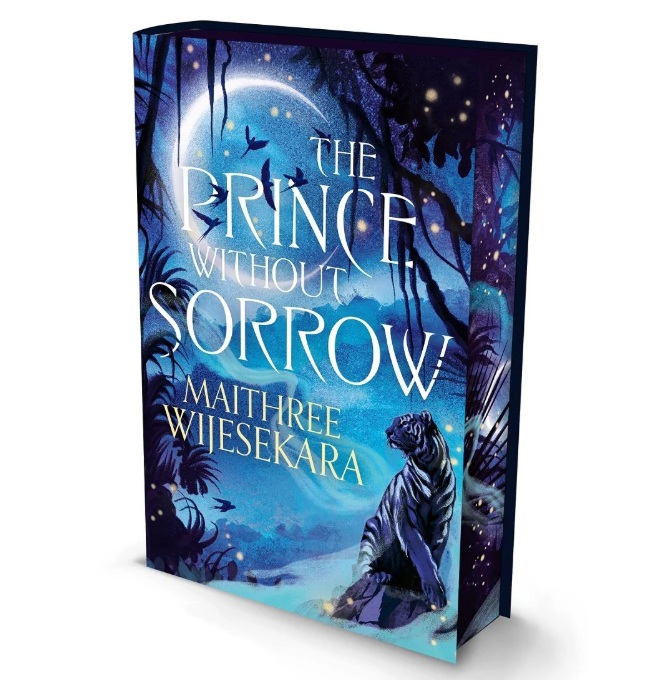
Image courtesy of Waterstones.
Final thoughts
Despite its flaws, I do think Wijesekara’s Obsidian Throne trilogy has potential, if the author learns from the missteps in this first book. I’m intrigued to see just how far Ashoka will go in his pursuit of peace, and whether he’ll realise that in trying to avoid becoming his father, he may be destined to follow in his footsteps. And I’m curious to see how Shakti plans to get herself out of the mess she’s (rather stupidly) landed in with Princess (or should I say Empress?) Aarya.
There’s promise here. But whether it can be fulfilled remains to be seen.